


The incident at Brownstone Peixin Kindergarten in Maiji District, Tianshui, Gansu Province has drawn widespread public attention: to enhance the visual appeal of food, a chef added industrial dyes clearly labeled “not for human consumption” to children's staple meals. Test results revealed severe lead contamination in some dishes (e.g., three-color steamed buns contained 1052mg/kg of lead, far exceeding national standards), leading to abnormal blood lead levels in hundreds of children. What is deeply troubling is the chain of problems exposed by this incident—from illegal additives, falsified hospital data, and operational errors at the disease control center to inadequate oversight by regulatory authorities—highlighting systemic vulnerabilities in public health defenses.
This shocking food safety scandal not only reveals regulatory lapses and institutional loopholes but also serves as a stark reminder that we must prioritize addressing hidden risks closely tied to public health. In the healthcare sector, particularly in dental procedures directly impacting patient health, complacency is equally unwarranted. To effectively prevent cross-infection and ensure treatment safety, establishing and rigorously implementing scientific sterilization protocols for dental instruments is paramount. Next, we will systematically outline the technical standards for sterilizing dental instruments.
Table of Contents
Foreword
1 Scope
2 Normative References
3 Terms and Definitions
4 Management Requirements
5 Fundamental Principles for Dental Instrument Processing
6 Operational Procedures for Dental Instrument Processing
7 Monitoring Requirements
8 Release of Disinfected and Sterilized Items
9 Instrument Storage
Appendix A (Normative Appendix) Training Content and Management Requirements
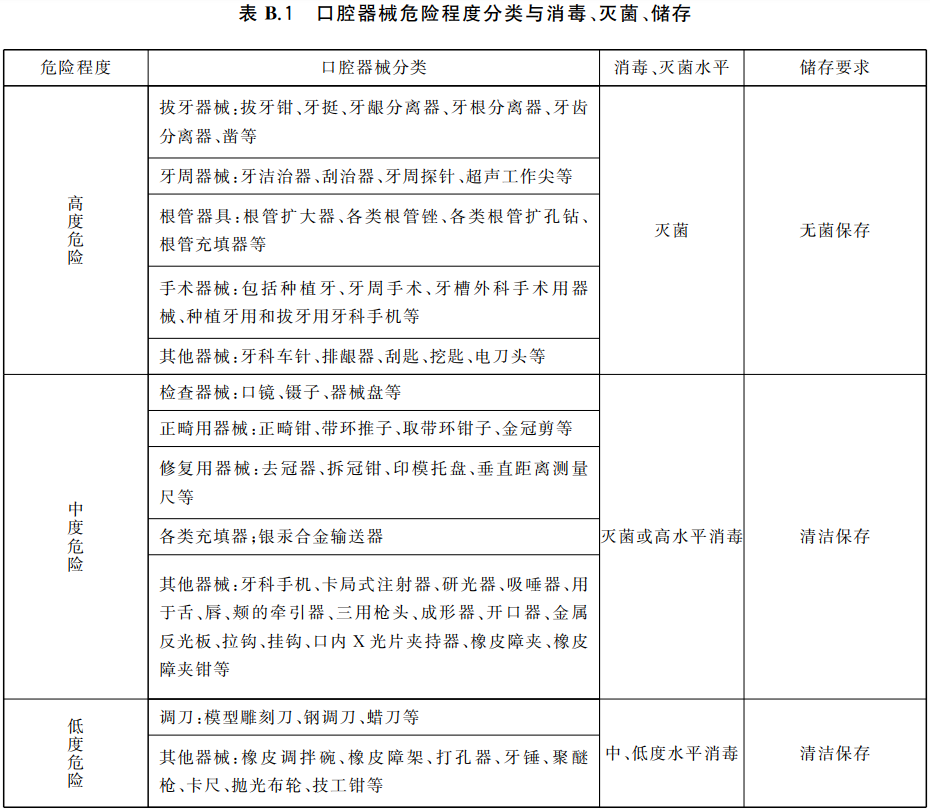
Appendix B (Normative Appendix) Classification of Risk Levels for Dental Instruments and Requirements for Disinfection, Sterilization, and Storage
Appendix C (Normative Appendix) Cleaning Methods for Instruments, Devices, and Items
Appendix D (Normative Appendix) Cleaning and Maintenance Methods for Dental Handpieces
Appendix E (Normative Appendix) Sterilization and Monitoring Requirements for Small Sterilizers
Appendix F (Informative Appendix) Sterilizer Sterilization Cycle Operation Record Form
Foreword
Clauses 4.2.2d), 4.3.3, 4.4.3, 6.1.2a) and c), 6.2.2, 6.2.3, 6.2.4, 6.3, 6.6.2, 6.6.3, 6.7.2, and 7.1.3 of this standard are recommended provisions (indicated with a blue background), while all other clauses are mandatory provisions.
This standard is formulated in accordance with the Law of the People's Republic of China on the Prevention and Treatment of Infectious Diseases and the Measures for the Management of Hospital Infections.
01 Scope
This standard specifies the management requirements, fundamental principles, operational procedures, sterilization monitoring, release of sterilized items, and storage requirements for dental instruments.
This standard applies to medical institutions at all levels and of all types that provide dental disease prevention, diagnosis, and treatment services. For institutions with centralized supply through a sterilization supply center, the disposal methods for dental instruments may be implemented in accordance with this standard.
02 Normative References
The following documents are essential for the application of this document. For dated references, only the edition cited applies. For undated references, the latest edition of the reference (including all amendments) applies.
GB 15982 Hygienic Standard for Hospital Disinfection
GB/T 19633 Packaging of Terminally Sterilized Medical Devices
WS 310.2 Central Sterile Supply Departments in Hospitals—Part 2: Technical Operating Procedures for Cleaning, Disinfection, and Sterilization
WS 310.3 Central Sterile Supply Departments in Hospitals—Part 3: Standards for Monitoring the Effectiveness of Cleaning, Disinfection, and Sterilization
WS/T 367 Technical Specifications for Disinfection in Medical Institutions
YY 0646 Automatic Small Steam Sterilizers
03 Terms and Definitions
The following terms and definitions apply to this document.
3.1 Dental Devices
Reusable instruments, appliances, and items used for the prevention, diagnosis, treatment of oral diseases, and oral health care.
3.2 Small Dental Devices
Dental instruments of smaller specifications, such as various sizes of burrs, root canal instruments, etc.
3.3 Dental handpiece
A handheld tool holder that transmits the energy required for operation to dental tools or instruments (with or without a converter).
3.4 Root canal instruments
Instruments used for probing, penetrating, preparing, or filling root canals, such as root canal files, root canal expanders, and root canal smoothing needles.
3.5 Dental scaler
A manual or electric dental instrument specifically designed and/or used to remove dental calculus from tooth surfaces.
3.6 Critical dental instruments
Dental instruments that penetrate soft tissue, contact bone, enter or contact blood or other non-sterile tissues.
3.7 Semicritical dental instruments
Dental instruments that come into contact with intact mucosa without entering sterile tissues, organs, or the bloodstream of the human body, nor contacting broken skin or damaged mucosa.
3.8 Noncritical dental instruments
Dental instruments that do not come into direct or indirect contact with the patient's oral cavity during oral healthcare services. While potentially contaminated with microorganisms, they are generally harmless and only pose a risk when contaminated with a significant quantity of pathogenic microorganisms.
3.9 Small Steam Sterilizer - Automatic Type
An automatically controlled steam sterilizer with a sterilization chamber volume not exceeding 60L, utilizing steam generated by electric heating or an external steam source. Hereinafter referred to as a small sterilizer.
3.10 Hollow Load A
Single-ended hollow loads with a length-to-diameter ratio (L/D) greater than or equal to 1 and less than or equal to 750 (1 ≤ L/D ≤ 750), and a length not exceeding 1500 mm (L ≤ 1500 mm); or double-ended hollow loads with a length-to-diameter ratio greater than or equal to 2, less than or equal to 1500 (2 ≤ L/D ≤ 1500) and with a length not exceeding 3000 mm (L ≤ 3000 mm), and does not fall under Class B Hollow Load.
Example: Dental handpieces are Class A Hollow Load devices.
[YY0646—2015, Definition 3.4]
3.11 Hollow Load B
A single-ended perforated load where the ratio of length (L) to hole diameter (D) is greater than or equal to 1 and less than or equal to 5 (1≤L/D≤5), and the hole diameter is not less than 5 mm (D≥5 mm); or a double-ended perforated load where the ratio of length to hole diameter is greater than or equal to 2 and less than or equal to 10 (2≤L/D≤10), and the hole diameter is not less than 5 mm (D≥5 mm).
[YY0646—2015, Definition 3.5]
3.12 Processing variable
A condition of the sterilization process whose variation affects the effectiveness of microbial inactivation.
3.13 Verification
The determination, based on objective evidence, that specified requirements have been fulfilled.
04 Management Requirements
4.1 Healthcare Institutions
4.1.1 Establish management systems for the disinfection and sterilization of dental instruments within the institution.
4.1.2 Designate a dedicated instrument processing area.
4.1.3 Staff the instrument processing area with full-time or part-time personnel based on the volume of dental services provided. All disinfection and sterilization personnel must complete pre-service training and continuing education, with training content outlined in Appendix A.
4.2 Instrument Processing Area
4.2.1 The area shall be commensurate with the scope and workload of dental services, with layout conforming to hospital infection prevention and control requirements.
4.2.2 The area shall be divided into:
a) Recovery and Cleaning Zone: Responsible for instrument recovery, sorting, cleaning, and drying.
b) Maintenance, Packaging, and Sterilization Zone: Responsible for instrument maintenance, inspection, packaging, disinfection, and/or sterilization.
c) The storage area holds disinfected/sterilized items and single-use sanitary supplies with outer packaging removed.
d) Dental clinics with low workload may omit the storage area, placing disinfected/sterilized items directly into instrument storage carts.
4.2.3 A physical barrier must separate the recovery and cleaning area from the maintenance, packaging, and sterilization area.
4.2.4 Workflow design shall progress from dirty to clean areas. Decorative materials shall be water-resistant and easy to clean. Piping for water, electricity, and gas shall be pre-installed according to the equipment configuration.
4.3 Equipment and Facilities
4.3.1 Equipment and facilities shall be reasonably configured based on the actual needs of dental services and shall comply with relevant national standards or regulations.
4.3.2 The facility shall be equipped with waste collection containers, manual washing sinks, workbenches, ultrasonic cleaners, and sterilization equipment.
4.3.3 It is recommended to provide mechanical cleaning and disinfection equipment, dedicated automatic lubrication and maintenance machines for dental handpieces, medical heat sealers, and drying equipment.
4.4 Consumables
4.4.1 Detergents: Must comply with relevant national standards or regulations. Select detergents suitable for dental instruments based on material type and contaminant characteristics.
4.4.2 Disinfectants: Must use legally approved and effective disinfectants.
4.4.3 Lubricants: Dental handpieces should use dedicated cleaning lubricants following manufacturer or supplier instructions. Water-soluble lubricants may be used for other dental instruments.
4.4.4 Packaging Materials: Disposable medical tissue paper, paper-plastic bags, paper bags, textiles, non-woven fabrics, etc., shall comply with GB/T 19633 requirements. Dental instrument cases shall provide a microbial barrier and be suitable for storing various types of instruments such as burrs and root canal instruments.
4.4.5 Disinfection and Sterilization Monitoring Materials: Shall be legally valid and used within their expiration dates.
05 Basic Principles for the Handling of Dental Instruments
5.1 Dental instruments shall be used once per patient and disinfected and/or sterilized.
5.2 High-risk dental instruments shall achieve sterilization.
5.3 Medium-risk dental instruments shall achieve sterilization or high-level disinfection.
5.4 Low-risk dental instruments shall achieve medium-level or low-level disinfection.
5.5 Refer to Appendix B for the classification of dental instrument risk levels and corresponding disinfection/sterilization requirements.
06 Dental Instrument Processing Procedure
6.1 Recycling
6.1.1 Used dental instruments shall be stored separately from waste items and recycled promptly.
6.1.2 Dental instruments shall be categorized and stored based on material, function, and processing method. Specific guidelines are as follows:
a) Complex instruments difficult to clean (e.g., small dental instruments, curettes) should be stored in a moist environment using tap water or enzymatic detergent as the moisturizing solution.
b) Dental handpieces, electric scalers, and electrosurgical units should undergo preliminary debridement and be stored in dry collection containers.
c) Other instruments may be placed in dedicated collection containers.
6.1.3 Collection containers should be cleaned, disinfected, and dried after each use for future readiness.
6.2 Cleaning
Dental instrument cleaning methods include manual cleaning and mechanical cleaning (including ultrasonic cleaning). Manual and ultrasonic cleaning procedures shall comply with Appendix C requirements; mechanical cleaning methods shall follow the manufacturer's instructions or manual.
6.2.2 Non-powered dental instruments may be cleaned mechanically.
6.2.3 Powered dental instruments and precision/complex instruments should be cleaned manually.
a) Disassemblable instruments should be cleaned separately after disassembly, e.g., electric scalers.
b) Handpieces of electric scalers should preferably be cleaned manually.
6.2.4 Ultrasonic cleaning is the preferred method for small dental instruments and other complex devices. Refer to Appendix C, Section C.2 for cleaning procedures.
6.2.5 Cleaning of dental handpieces must comply with Appendix D requirements.
6.3 Drying
6.3.1 Drying equipment should be used for drying instruments and devices. Select appropriate drying temperatures based on material:
- Metal: 70°C to 90°C
- Plastic: 65°C to 75°C
6.3.2 For instruments/devices without drying equipment or those heat-sensitive, use low-lint cloths for drying.
6.4 Inspection and Maintenance
6.4.1 Visually inspect dried dental instruments or use a lighted magnifying glass. Instrument surfaces, spiral structures, and joints must be free of stains, water marks, residual substances, and rust spots. Re-process instruments failing cleaning quality standards; promptly replace damaged or deformed instruments.
6.4.2 Maintenance of dental handpieces is detailed in Appendix D.
6.5 Selection of Disinfection Methods
6.5.1 Wet heat sterilization is the preferred physical disinfection method, with parameters complying with WS 310.2 requirements. Disinfection methods for washer-disinfectors are specified in Appendix C, Section C.3.
6.5.2 Chemical disinfection methods must meet WS/T 367 requirements.
6.6 Packaging
6.6.1 Packaging materials shall be selected based on instrument characteristics and usage frequency.
6.6.2 Low- and medium-risk dental instruments may be stored directly in clean, ready-to-use containers after disinfection or sterilization without packaging.
6.6.3 Small dental instruments should preferably be stored in dental instrument cases.
6.6.4 Packaging requirements are as follows:
a) Sterilization chemical indicators shall be affixed externally, along with labels indicating item name, packer, sterilizer number, sterilization batch, sterilization date, and expiration date. Sterilizer number may be omitted if only one sterilizer is used.
b) Chemical indicators shall be present both inside and outside oral surgery procedure packs.
c) For paper-plastic pouches, the seal must be intact with a width ≥6mm, and instruments must be positioned ≥2.5cm from the pouch seal. Paper pouches must have an intact seal.
d) Medical heat sealers must undergo parameter accuracy checks before daily use.
6.7 Selection of Sterilization Methods
6.7.1 Pressure steam sterilization shall be the preferred method for dental instruments. When using small autoclaves, sterilization shall comply with the requirements of Appendix E.
6.7.2 Dry heat sterilization is recommended for instruments made of carbon steel.
6.7.3 Other sterilization methods shall comply with the requirements of WS 310.2.
07 Monitoring Requirements
7.1 Disinfection Monitoring
7.1.1 Moist Heat Disinfection: Temperature and duration shall be monitored and recorded for each cycle.
7.1.2 Chemical Disinfection: Concentration of chemical disinfectants and disinfection duration shall be monitored periodically according to the disinfectant type and recorded.
7.1.3 Disinfection Effectiveness Monitoring: Items used directly after disinfection shall be monitored at least quarterly. Monitoring methods and result interpretation shall comply with WS/T 367 requirements.
7.2 Sterilization Monitoring
7.2.1 Monitoring of small sterilizers shall comply with Appendix E.
7.2.2 Monitoring of other sterilizer methods shall comply with relevant provisions of WS 310.3.
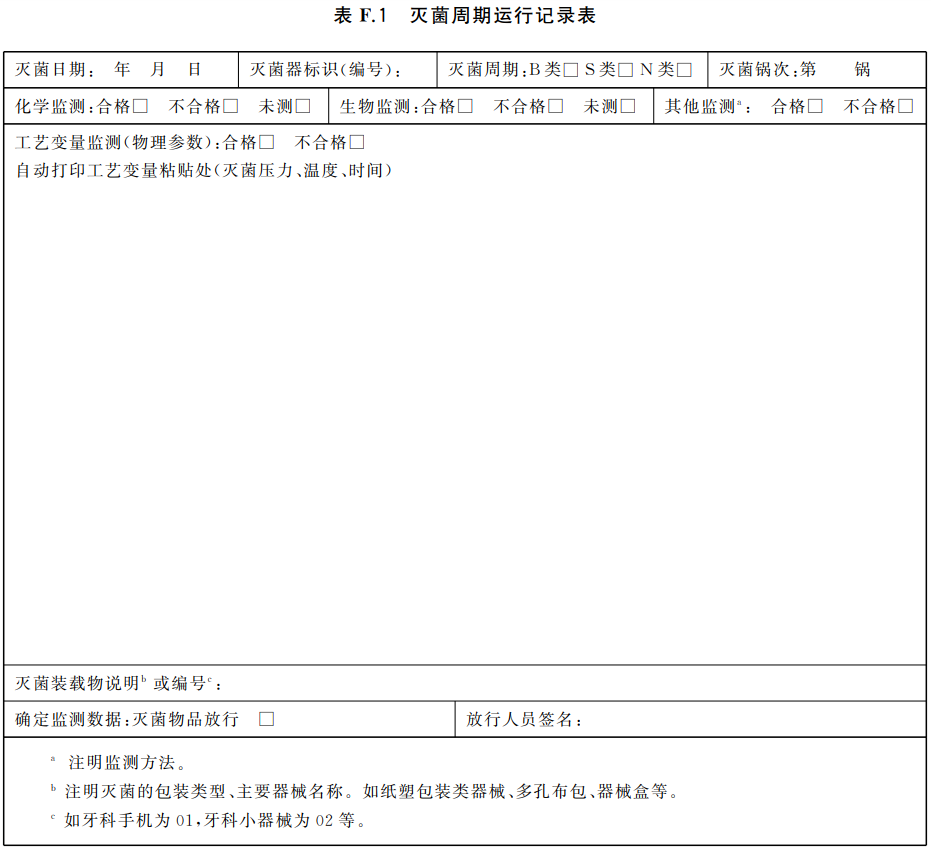
7.2.3 Each sterilization cycle operation shall be documented. Records shall be retained for 3 years. The record format and content are specified in Appendix F.
08 Release of Disinfected and Sterilized Items
8.1 Release of Disinfected Items
8.1.1 For mechanical thermal disinfection, rated parameters (temperature, time) shall be verified. Disinfected items may only be released when the obtained parameters meet requirements.
8.1.2 When disinfecting items with chemical disinfectants, verify disinfection duration and concentration. Items may be released only when these meet the requirements of WS/T 367.
8.2 Release of Sterilized Items
8.2.1 After each sterilization cycle, inspect all physical parameters and chemical indicators. Sterilized items may be released only when the obtained data and indicator displays align with the specified sterilization parameters.
8.2.2 Items shall not be released if any monitoring or parameters during the sterilization cycle fail to meet specifications. The cause of sterilization failure must be investigated. After readjustment, physical and chemical monitoring shall be repeated. The sterilizer may be reused only after passing verification. Biological monitoring shall be conducted when necessary, and the entire process shall be documented.
09 Equipment Storage
9.1 Storage areas shall be equipped with storage cabinets (racks) or carts, which shall be cleaned and disinfected weekly. The following precautions shall be observed:
a) Sterilized items and disinfected items shall be stored separately with clear labeling;
b) The storage validity periods for sterile items in sterilized packaging are as shown in Table 1;

c) Bare sterilized and generally packaged high-risk dental instruments should be used immediately after sterilization, with a maximum delay not exceeding 4 hours;
d) Medium- and low-risk dental instruments should be stored in clean, dry containers after disinfection or sterilization, with storage duration not exceeding 7 days.
9.2 The storage room environment shall comply with the requirements of GB 15982.
10 Appendix A
(Normative Appendix)
Training Content and Management Requirements
A.1 Medical institutions shall provide disinfection and sterilization personnel with opportunities to participate in technical training, which shall be documented in writing or evidenced by certification.
A.2 Full-time and part-time disinfection and sterilization personnel shall participate in specialized technical training on disinfection and sterilization at least once annually.
A.3 Training content shall include knowledge related to the Law on the Prevention and Control of Infectious Diseases, the Hospital Infection Management Measures, WS/T 367, prevention of occupational exposure, as well as the training content listed in Table A.1 and the provisions of this standard.
Appendix B
(Normative Appendix)
Classification of Hazard Levels for Dental Instruments and Requirements for Disinfection, Sterilization, and Storage
The classification of hazard levels for dental instruments and requirements for disinfection, sterilization, and storage are shown in Table B.1.
Dental handpieces should be cleaned and stored after sterilization.
Appendix C
(Normative Appendix)
Cleaning Procedures for Instruments, Devices, and Articles
C.1 Manual Cleaning
C.1.1 Procedure
C.1.1.1 Rinsing: Place instruments, devices, and items under running water to rinse and remove initial contaminants.
C.1.1.2 After rinsing, soak in an enzymatic detergent or other cleaning agent, then scrub or wipe.
C.1.1.3 Rinse: After scrubbing or wiping, rinse again with running water.
C.1.2 Precautions
C.1.2.1 Water temperature for manual cleaning should be 15°C to 30°C.
C.1.2.2 For removing dried-on stains, first soak in an enzymatic detergent. Refer to the manufacturer's instructions for soaking time and detergent concentration. After soaking, proceed with scrubbing or wiping.
C.1.2.3 Scrubbing should be performed underwater to prevent aerosol generation.
C.1.2.4 Lumen instruments should be flushed with a pressure water jet. Detachable parts should be disassembled for cleaning.
C.1.2.5 Appropriate scrubbing tools and supplies should be selected to prevent instrument wear.
C.1.2.6 Cleaning tools, sinks, and other equipment should be cleaned and disinfected daily.
C.2 Ultrasonic Cleaning
C.2.1 Operating Procedures
C.2.1.1 Rinsing: Rinse instruments under running water to preliminarily remove contaminants.
C.2.1.2 Washing: Fill the washer with washing water and add detergent. Water temperature should be ≤45°C. Place instruments in baskets, submerge them below the water surface, and fill lumens with water.
C.2.1.3 Final Rinse: Rinse with running water.
C.2.1.4 Ultrasonic cleaning operations shall follow the manufacturer's instructions or user manual.
C.2.2 Precautions
C.2.2.1 Keep the ultrasonic cleaner lid closed during cleaning to prevent aerosol generation.
C.2.2.2 Select appropriate ultrasonic frequency and duration based on the material of the instruments.
C.2.2.3 Use dedicated mesh baskets for ultrasonic cleaning of small dental instruments.
C.3 Automated Cleaning and Disinfection
C.3.1 Suitable for cleaning and disinfecting items resistant to moist heat, such as glass mixing bowls, metal mixing blades, and rubber bowls.
C.3.2 Select appropriate washing racks based on instrument shape and characteristics; delicate and sharp instruments should be secured in place.
C.3.3 Water used in the washer-disinfector must comply with the equipment manual specifications; pre-wash water temperature should not exceed 45°C. C.3.4 Disinfection temperature and duration must meet WS310.2 requirements.
C.3.5 Regularly inspect the cleaning and disinfection efficacy of the equipment.
C.3.6 Precautions are as follows:
a) Disassemble instruments for cleaning; fully open all joints.
b) Verify disinfection parameters when selecting different cleaning and disinfection programs.
c) Periodically check for blockages in detergent pumps and tubing.
Appendix D
(Normative Appendix)
Cleaning and Maintenance Methods for Dental Handpieces
D.1 Principles for Cleaning and Maintenance of Dental Handpieces
D.1.1 Select appropriate cleaning and maintenance methods based on the internal structure or function of the dental handpiece.
D.1.2 For specialized dental handpieces, follow the manufacturer's or supplier's instructions for cleaning and maintenance.
D.2 Cleaning Methods for Dental Handpieces
D.2.1 Manual Cleaning Method
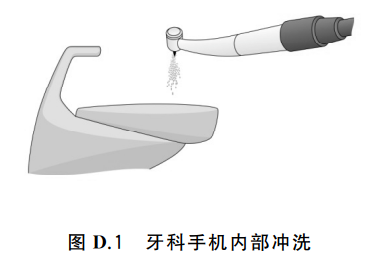
D.2.1.1 After use, with the contra-angle handpiece attached, flush the internal water and air passages for 30 seconds using the water and air systems of the dental unit, as shown in Figure D.1.
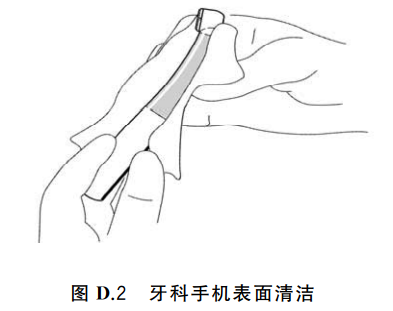
D.2.1.2 Remove the dental handpiece from the quick-connect coupling or cable, detach the chuck, and clean off surface contaminants, as shown in Figure D.2.
a) For fiber-optic dental handpieces, use an air gun to blow away particles and dust from the fiber surface, then wipe away any stains;
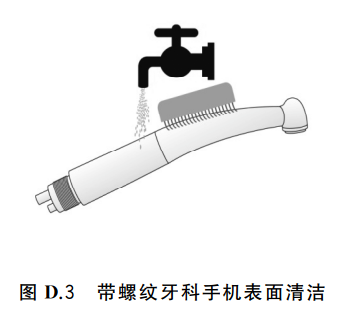
b) For threaded dental handpieces, clean the surface with a soft-bristled brush under running water, as shown in Figure D.3.
D.2.1.3 Clean the dental handpiece's air inlet tubing using pressurized cleaning lubricant, or flush the internal air inlet tubing with a pressurized water gun, then dry it using a pressurized air gun.
D.2.1.4 Precautions are as follows:
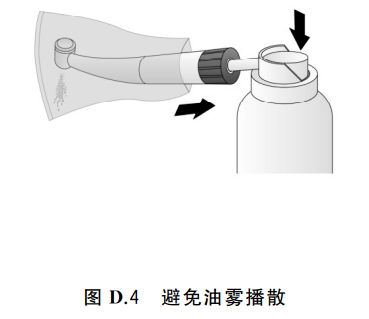
a) When using pressurized cleaning lubricant, cover the handpiece head with a transparent plastic bag or paper towel to prevent oil mist dispersion, as shown in Figure D.4;
b) Detachable components of implant-specific handpieces should be disassembled for cleaning; non-detachable implant-specific handpieces may be cleaned internally using a high-pressure water jet;
c) After cleaning dental handpieces with a high-pressure water jet, promptly dry internal air passages using a high-pressure air gun to prevent bearing damage;
d) Operating pressure for water and air guns should range between 200 kPa and 250 kPa, not exceeding the pressure specified in the dental handpiece manual;
e) Dental handpieces must not be immersed in liquid solutions for cleaning;
f) When using canned cleaning lubricant to clean internal components, if contaminants flow from the head section, repeat procedure D.2.1.3 until no contaminated oil is discharged.
D.2.2 Mechanical Cleaning Methods
D.2.2.1 Surface cleaning shall comply with D.2.1.2.
D.2.2.2 Place the dental handpiece in the mechanical cleaning device, secure it, and select the appropriate cleaning program.
D.2.2.3 The mechanical cleaning device shall be equipped with a dedicated dental handpiece interface, with water and air flow patterns matching the internal structure of the handpiece.
D.2.2.4 Deionized water, softened water, or distilled water should be used in the mechanical cleaning device.
D.2.2.5 Precautions are as follows:
a) The power motor should not be cleaned using the mechanical cleaner;
b) Internal tubing of the dental handpiece should be thoroughly dried after cleaning;
c) Ultrasonic cleaning is not recommended for dental handpieces;
d) Dental handpieces should not be cleaned simultaneously with other oral instruments.
D.3 Maintenance of Dental Handpieces
D.3.1 Manual Maintenance Methods
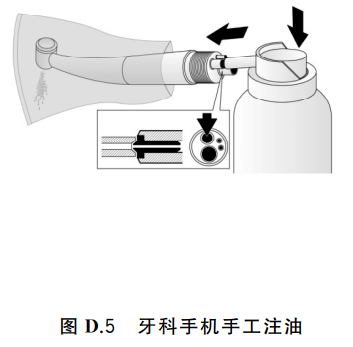
D.3.1.1 Inject lubricating oil into the dental handpiece using a pressure-filled lubricant container connected to a matching oil injection adapter or connector, as shown in Figure D.5.
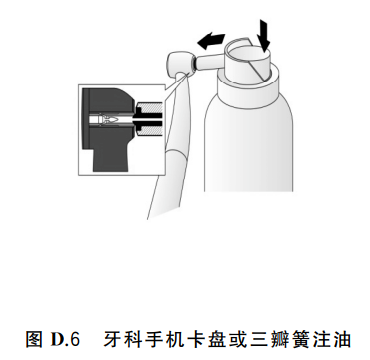
D.3.1.2 The clamping mechanism (chuck or three-jaw chuck) of dental handpieces shall be lubricated daily, as shown in Figure D.6.
D.3.1.3 For dental handpieces with internal oil circuits, lubricate the chuck or three-leaf spring and bearings using a grease gun, as shown in Figure D.7.
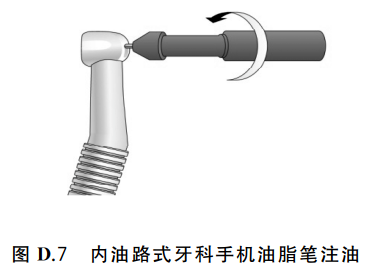
D.3.1.4 Lubrication of low-speed dental handpieces and dental straight handpieces may follow the above lubrication methods (where applicable). For special lubrication procedures, refer to the manufacturer's or supplier's instruction manual.
D.3.1.5 Precautions are as follows:
Secure the lubrication connector to the dental handpiece's lubrication point during cleaning and lubrication to ensure effective lubrication;
Prevent oil mist dispersion in accordance with D.2.1.4a) requirements;
When cleaning dental handpieces using pressurized canned cleaning lubricants, no additional lubricant injection is required.
D.3.2 Mechanical Maintenance Methods
D.3.2.1 Connect the dental handpiece to a compatible lubrication adapter or connector, then insert it into the automatic lubrication maintenance machine for lubrication.
D.3.2.2 Select the appropriate lubrication program.
D.4 Alternative Methods
Dental handpieces may optionally undergo cleaning, lubrication, and sterilization using an integrated cleaning-lubrication-sterilization machine.
Appendix E
(Normative Appendix)
Sterilization and Monitoring Requirements for Small Sterilizers
E.1 Sterilization Requirements
E.1.1 Sterilization Cycles
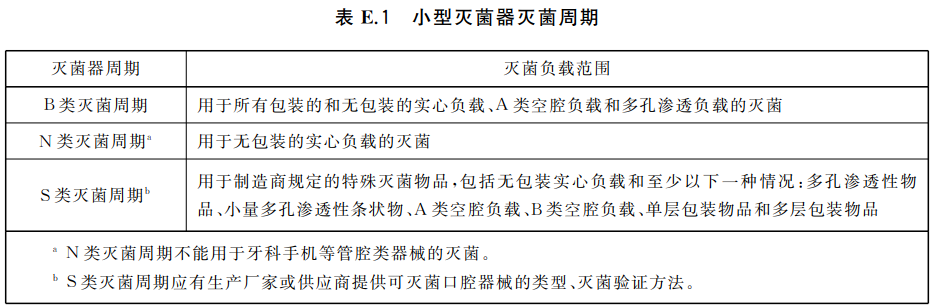
E.1.1.1 Select sterilization cycles based on the hazard level of items to be sterilized and load range. Cycles for small sterilizers are specified in Table E.1.
E.1.1.2 Sterilization cycles and associated settings for different classifications shall only be applied to sterilization of designated item types. Sterilization processes for specific loads require validation.
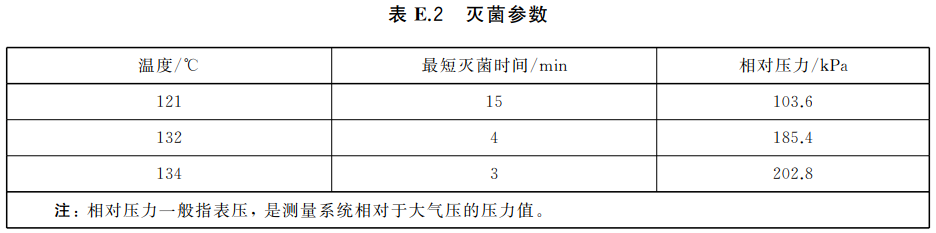
E.1.2 Sterilization Parameters
Sterilization parameters are specified in Table E.2.
For the upper temperature limit and relative pressure fluctuation range during operation, refer to the user manual of the small sterilizer.
E.1.3 Pre-Sterilization Preparation
E.1.3.1 Conduct a safety inspection before daily equipment operation, including:
- Pressure gauge positioned at “zero”;
- Recording printer in standby mode;
- Sterilizer door gasket flat and free of loosening;
- Door safety latch operates smoothly for opening and closing;
- Condensate drain inside the chamber unobstructed;
- Power supply, water source, and other connections properly secured.
E.1.3.2 Turn on the power, preheat the unit, and select the appropriate sterilization cycle.
E.1.3.3 Water used in the sterilizer must comply with YY0646 requirements.
E.1.4 Sterilization Loading
E.1.4.1 Sterilized items must not exceed the sterilizer's maximum load capacity.
E.1.4.2 The sterilizer must be equipped with sterilization racks or trays. Trays must have sufficient perforations to allow steam penetration.
E.1.4.3 Use sterilization racks to arrange packaged items, leaving adequate spacing between items.
E.1.4.4 When using trays to arrange paper/plastic-wrapped instruments and unwrapped instruments, arrange them in a single layer without stacking.
E.1.4.5 Accessories should be sterilized separately, such as dental handpieces and burs, electric scaler handles and working tips, etc.
E.1.4.6 Items awaiting sterilization should be dry before loading into the sterilizer.
E.1.5 Sterilizer Maintenance
E.1.5.1 Sterilizers should be maintained according to the manufacturer's or supplier's instructions.
E.1.5.2 Sterilizer operators shall perform daily maintenance, including inspecting door seals, drain filters, cleaning interior/exterior surfaces, and replacing recorder paper.
E.1.5.3 Calibration or replacement of consumable components—such as recording devices, filters, steam valves, drain pipes, and seals—shall be performed by professionally trained personnel.
E.1.5.4 Comprehensive maintenance by professionals shall be performed when the sterilizer reaches 12 months of use or experiences operational malfunctions.
E.1.5.5 Written records shall be maintained for all routine maintenance, annual maintenance, repairs, or adjustments of the sterilizer.
E.2 Sterilizer Monitoring Requirements
E.2.1 Physical Parameter Monitoring
E.2.1.1 Physical parameters shall be monitored and process variables recorded for each sterilization cycle.
E.2.1.2 Process variables and their change curves shall be automatically monitored and printed by the sterilizer.
E.2.1.3 Process variable results shall comply with the sterilization parameter requirements specified in Table E.2 of Appendix E.
E.2.2 Chemical Monitoring
E.2.2.1 Chemical monitoring shall be performed for each sterilization cycle, and the monitoring results shall be recorded.
E.2.2.2 For chemical monitoring, place the chemical indicator inside a representative, commonly used sterilization pouch or tray and position it in the most difficult-to-sterilize area of the sterilizer. For solid instruments undergoing exposed sterilization, the chemical indicator may be placed next to the instrument for monitoring. For hollow instruments, chemical PCDs may be selected for monitoring.
E.2.2.3 Exposure to sterilization process variables or achievement of sterilization requirements shall be determined by observing color changes in chemical indicators.
E.2.3 Biological Monitoring
E.2.3.1 Biological monitoring packs shall be prepared using representative sterilization packs commonly used in the sterilizer, or biological PCDs shall be used. They shall be placed in the most challenging sterilization location within the sterilizer, which must be fully loaded.
E.2.3.2 In-service sterilizers shall undergo biological monitoring monthly.
E.2.3.3 Biological monitoring methods and result evaluation shall comply with the requirements of WS 310.3.
E.2.4 Precautions
E.2.4.1 Small sterilizers shall undergo simultaneous physical, chemical, and biological monitoring after 12 months of continuous use or following maintenance. Sterilizers may resume normal operation only upon passing all tests.
E.2.4.2 Sterilization performance verification shall be conducted for newly installed small sterilizers or those with replaced major components. Verification methods shall comply with relevant national requirements.
Appendix F
(Informational Appendix)
Sterilizer Sterilization Cycle Operation Record Form
The sterilizer sterilization cycle operation record is shown in Table F.1.
【Disclaimer】
WOSON Medical Devices publishes the above content while maintaining neutrality regarding the statements and opinions expressed herein. We make no express or implied warranties as to the accuracy, reliability, or completeness of the included content. Should you believe our attribution or source citation is inaccurate, please notify us. We will actively engage in discussions with you to resolve the matter. Thank you for your attention.
